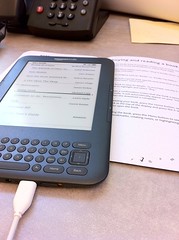
One of the really nice things about the Kindle is that it's a lot
easier to know what books I've read this year. While it's not
exhaustive, as I still have a hardcopy book habit going on, the Kindle
took over a lot of my reading. The kindle website also makes it pretty
easy to pull out a list of what you've read and any highlighted
passages and notes.
What follows is a brief summary of all the fiction I read on the Kindle - I may go back and add some physical books I read as well as I remember what they were (all I really remember is Sophie's Choice, but I'm sure there were others). All quoted passages are ones I highlighted as reading - the number of quotes is probably some indication of how much I enjoyed some of the writing in the book.
I'll be adding non-fiction (a somewhat shorter list) in a future post.
I enjoy Elliott's unadorned style, which feels very honest and
open. The book is a mix of memoir and true-crime book as Elliott
becomes obsessed with the Hans Reiser murder case while also suffering
from a bad case of writer's block. He totally nails the technical
details when explaining what a file system, which is always nice to
see in a non-technical book. Recommended.
And if you're like me, that's going to be a time when you're making
your living selling drugs out of your freezer, living in a squat a
bullet away from Cabrini Green. You'll have to represent something,
like the other side of the tracks, but safe. Someone who, when the
time comes, when the party's over, she can turn around and guide to
a place where life is a little more predictable. But when the party
was over I didn't want to turn around. I didn't want to go to law
school or get a real job or love only one person forever though in
many ways she was the most loveable person I was ever going to
meet. It didn't matter. I had to test my dissatisfaction.
Anathem by Neal Stephenson
Stephenson is one of my favorite authors, so I was well prepared to be
totally into this book. Ultimately, though, my feelings on it were
mixed. Some of this was probably due to the made up word
problem, but I think the overall issue was that
the emphasis was ultimately too much on world-building, not enough on
exploring the world. There was still lots of great writing and enough of
a narrative drive to get me through all 960 pages, so maybe I just
need to try again?
"Our opponent is an alien starship packed with atomic bombs,"" I said. "We have a protractor."
The Ask by Sam Lipsyte
Loved it. Can't say enough good things about Lipsyte. If funny and
profane writing is your thing, you owe it to yourself to read
everything he's written. (I am totally serious).
All was peachy and near utopic until I rose for a beer. At that
moment the knowledge just disappeared, tilted out my earhole. I'd
have to start again, or else concede my memory palace was a panic
room.
There was Bernie on the sofa, watching his favorite show, the one where children mutated into gooey robots, sneered. It was like a parable from a religion based entirely on sarcasm.
As will become abundantly clear, I went on a major Stross bender this
year. I go through an on-again, off-again relationship with sci-fi,
and Stross flipped the bit to fully on. I first came across Stross
because of his
blog, and
I've now bought enough of his books that the royalties should cover at
least a month of hosting.
This book is the first in The Laundry Files series, and I think it's a
good starting point to get into Stross (this or Halting State) as it
plays to his strengths as a writer: funny, deeply and knowledgeably
geeky, strong and clever narrative. The Laundry Files concerns a
secret British spy agency called The Laundry that deals with a
Lovecraftian underworld of magic, zombies, demons, and other nasty
stuff that the general population would rather not know about. The
funny comes in large part due to The Laundry also being a horrendous
government bureaucracy that the geeky hero (Bob Howard) has to navigate
while trying to prevent the destruction of the known universe.
An intertwined story of people reinventing their lives. It's well
written and the story pulled me along with its whodunit-level urgency,
but it hasn't really stuck with me. This may be due to a general
resistance I have to stories where unrelated characters end up being
'unexpectedly' involved with each other - while this can be a reliable
way to keep up narrative drive, as you get to see the connections
before the characters do and want to see how the stories ultimately
join, it tends to make me think too much of the structure underlying
what's going on, and once I'm paying more attention to the
architecture, I start to see the characters as less alive.
See this for an
alternate view - it's what convinced me to read it, although I
ultimately ended up not agreeing with their take.
Detective novels set in Bangkok. As I read the second one, you can
surmise that they're not horrible. As I didn't read the third, you can
surmise they're not fantastic. Burdett gets a lot of mileage from his
atypical detective, a half-Thai buddhist police detective named
Sonchai Jitpleecheep, and the lurid Bangkok setting. Not that I think
Bangkok is lurid, but when your main character is the son of a
prostitute and partner in her new bar venture, lurid is kind of what
you get. Sonchai's buddhism is rendered respectfully and with some
depth, but there's a certain level of belief that must be suspended to
think this is a very true representation of how a Thai character might
think, constant references to the reader as Farang aside.
If you can get past the problematic issues of representation of
national character by a non-native, the books are fun, and do contain
what would seem to be a certain insider
knowledge
of the prostitution game in Thailand.
Loved it. Somewhat of a departure for Mieville, as it's as much a
detective novel as a sci fi novel. The setting for the novel is the SF
part: a city that is actually two cities at once co-existing with each
other by means of 'unseeing' the inhabitants and buildings of the
other city. It's a rich premise that I could imagine being the basis
of a Saramago novel, but in the case it's the setting for a murder
mystery that has a cynical detective moving between the two cities to
attempt to solve the case.
Highly recommended.
Horror sci-fi. Liked it enough to read both. Completely genre, but not generic.
Basis for the movie, which is mostly famous now for Dueling Banjos and Ned
Beatty squealing like a pig. I decided to read it because of Dwight
Garner's 40th anniversary
article,
and am glad I did. Garner notes that it does seem to be a type of book
that isn't really written any more, and I would tend to agree -
manliness is not the same thing it was 40 years ago, culturally
speaking.
Time-capsule nature aside, this is a pretty great book. Dickey's
characters are real, and his eye is fantastic.
One of the classic space opera novels. It is kind of fun to note how
the usenet-like news communication system dates the novel in certain
ways, as I don't think this aspect would be constructed in the same
way were it to be written today. This is not really a criticism, just
an observation as to how the technology of the day can fix even the
most forward looking novel to a particular time and place. I'm sure
the space operas of today will look weirdly web-centric in 20 years as
well.
That observation aside, this novel is a lot of fun, and has a crazy
amount of imagination and verve in the world building. One example:
one of the worlds involved in the main plot is dominated by a
dog/wolf-like race where an 'individual' is actually formed from at
least 3 separate creatures that communicate via high-frequency
sound. The ramifications of this are well integrated into the story
and fun to figure out.
The third Laundry Files novel. Recommended.
My least favorite of the Stross novels I read this year. The basic
idea of consciousness that can be transferred to different bodily
forms is fun enough, but the basic engine of the plot - main character
ends up in a simulacrum of present day culture, and mayhem eventually
ensues - fell flat for me, and I could see all the cultural commentary
coming from a million miles away: sexual hang-ups, misogyny,
etc. etc.
From my least favorite Stross to one of my favorites - as mentioned
above, I think this is a good starting point for Stross. Set in a
near-future of pervasive augmented reality and seriously massive
multiplayer games, it follows three main characters as they try and
solve a massive theft from a MMO. Tons of fun, well-written, and
soaked in some serious nerd cred.
Look, I know it's Young Adult ok? At the time, I needed something non-taxing, and
for some reason a tween-oriented running game dystopia seemed like the
way to go. Recommended if you want to have something to talk about
with your 12 year old niece or some-such; judging by the sales figures
they've all read these. And at least with these you don't have sparkly vampires.
Sequel to Singularity Sky. Great space opera fun.
Second book in The Laundry Files series. Great fun.
Kraken by China Mieville
Neverwhere + The Laundry Files + Cthulhu = pretty great,
actually. All hell breaks loose (literally!) when a preserved giant
squid is stolen from a London museum. You can tell Mieville had tons
of fun writing this.
One of those classic novels I've always been intending to read. Now I
have. Really liked it.
Multiworld alternate history high fantasy that is ultimately about
developmental economics. Tremendous fun, and Stross' ability to
develop the ramifications of his ideas is fantastic. This is a
six-volume series, but they're pretty quick reads, and now that
they're all published there's no worries about cliffhangers that won't
be resolved for a year.
If that's not convincing enough, how about the fact that Nobel-prize
winning economist Paul Krugman is a huge
fan?
I certainly didn't intend for this to be The Year I Read Space Operas,
but here we are. As a bonus, this one also covers the Singularity, a
popular feature of the genre. I enjoyed it, and you will too if the
terms Space Opera and Singularity are meaningful to you.
Lovely and sad novel about a girl who can taste other people's emotions
through the food they make. I hadn't really known of Bender before coming
across an
interview
that made me curious about her work, and I'm sure I'll be reading
more. Bender has a very observant eye, and uses the fanciful well in
exploring her character's emotions.
Find a Wife hadn't been on any visible list, but he'd proposed earlier than most of his peers and something did seem to get checked off inside him once they were married.
Mom's smiles were so full of feeling that people leaned back a
little when she greeted them.
Several of the girls at the party had had sex, something which sounded appealing but only if it could happen with blindfolds in a time warp plus amnesia.
Second book in the Red Thunder trilogy, this is Varley in nearly
full-on Heinlein mode. (thankfully not late Heinlein,
either). Enjoyable, but thin. Haven't picked up the third in the
series yet, as there seem to be some diminishing returns.
Speaking of late Heinlein modes... ok, yes, this is novel about an
obsolete sexbot. Stross mostly avoids the misogyny, at least, and
crafts an entertaining novel about, yes, an obsolete sexbot (humans
are extinct) attempting to carve out a life for herself in a plot that
stretches across the solar system.
Savages by Don Winslow
Picked this up because of a rave
review,
but was not similarly blown away. It's a supercharged crime novel, and
while it certainly has a high energy level, I actually found the
characters thin and unlikeable - often just barely functional as
schematics in the plot. Maybe I've been away from the crime genre for
too long, or read this when I wasn't in the right frame of mind for it
- Winslow has lots of fans, and there was a lot done right.
Unsentimental but beautiful story of surviving the siege of
Leningrad. Oddly,
this kind of made me want to visit Saint Petersburg, as it does such a
great job of generating a feeling of place that I'd like to find out
if it matches.
Space Opera! Singularity! Stross! Need I say more? (I really liked
it. Treading some common paths, but with a hell of a lot of flair.)
The story of how Skippy, well, dies, amidst the chaotic world of a Catholic boys' school
in Dublin. Very ambitious, funny, and ultimately sad. Murray can turn
a hell of a phrase.
Wherever he goes it is with two or three bodies' worth of empty
space around him, as if he's accompanied by an invisible retinue of
pitchfork-wielding goblins, ready to jab at anyone who happens to be
harbouring an impure thought.
Dennis, an arch-cynic whose very dreams are sarcastic, hates the
world and everything in it, Ruprecht, and has never
thrown himself into anything, with the exception of a largely
successful campaign last summer to efface the first letter from
every manifestation of the word 'canal' in the Greater Dublin Area,
viz. the myriad street signs proclaiming ROYAL ANAL, WARNING! ANAL,
GRAND ANAL HOTEL.
Afterwards, the team huddles shivering by the doorway of the
changing room, hands pressed under armpits. When you get out of the
water the air feels cold and nothingy. Your arm moves and it moves
against nothing. You speak and the words disappear instantly.
It's no secret that Father Green hates teaching, and he especially
hates teaching French. Lessons are frequently suspended for tirades --
usually directed at Gaspard Delacroix, the unfortunate exchange
student -- on the subject of France's decadence. He seems to believe
the language itself to be morally corrosive, and most of the class
is spent doing grammar, where its grossness can be partly contained;
even then, those languorous elisions, those turbid glottals, enrage
him. But what doesn't enrage him? Air particles enrage him.
'Violence solves everything, you idiot, look at the history of the
world. Any situation they have, they dick around with it for a
while, then they bring in violence. That's the whole reason they
have scientists, to make violence more violent.'
A post-apocalyptic world without zombies - is that allowed?
Apparently yes! 'The Sleepless' of the title are the victims of a
disease that robs them of the ability to sleep, so while zombie-esque,
they have none of the typical zombie traits (violence,
face-gnawing). On top of this milieu is a crime thriller that's
ultimately about trying to find hope in a hopeless situation. Nicely
done characters, tightly plotted, recommended.
After a generally well regarded debut novel, Then We Came to the
End, this one really seemed to divide people. The main driver of the
plot is the main character's periodic uncontrollable urge to walk. On
this somewhat silly-sounding premise, Ferris builds a melancholy tale
of love and loss that definitely wouldn't work if Ferris wasn't such a
compelling and controlled writer. I found myself drawn into the world
and characters, and felt the melancholy of the ending
well-earned. Recommended.
Also winner of the title of the year. Darkly funny story of two
sisters that are pretty much the opposite of each other. Not going to
say more, as I'm just going to say it's a lot of fun.
Mother lived in a magical world, where the unbearable was blinked
away even if it was ululating and pointing and hopping up and down
in front of you, and the past was always rosier than actual
experience.
Committees turn these things out. They probably had some kind of
poster contest, and this won. A group of educated adults decided how
many tens of thousands of these things to create, and how to
disseminate them, and of course the government's in on it, and it's
a federal offense not to put this up on a restaurant wall, and every
day millions of people look at it, whether they realize it or not,
and the real message comes through, sinks in, we absorb it like
trees absorb carbon dioxide, and the message is: THERE IS NOTHING SO
OBVIOUS SO NATURAL SO INSTINCTIVELY RIGHT THAT IT CANNOT BE SPELLED
OUT AND MADE SIMPLE ENOUGH FOR A MORON LIKE YOU.
There's even a best-selling paperback novelist living in Frome,
Dante Minuto, whom none of us has ever seen, who writes Ludlumesque
thrillers with Ludlum-esque tides, like The Marchpane Cicatrix and
The Wiesenheimer Punctilio.
they were encapsulated in that aura of intimacy and exclusivity that
young couples cast about themselves like a toreador's flashy
cape. She was playing wife, he was playing husband, and they were
both full of shit.
Sequel of a sorts to Oryx and Crake.
Atwood writes great dystopias, and this continues in that
tradition. While not at The Road levels, you shouldn't look to this
to cheer you up, unless considering the all-too-possible
self-annhilation of the human race really does it for you.




Recent Comments